
Most band saws ship with either no fence or a piece of pressed steel that bolts square to the table. Both are a problem, and the second is arguably worse, because a fence that is square to the table but not to the blade’s actual cutting line will fight you on every cut.
Every band saw blade has drift: a natural angle it wants to cut at, caused by the tooth set, the weld and how the blade tracks on the wheels. It is not a fault. It changes with every blade. A usable fence has to be adjustable to match it.
That single feature separates the fences worth buying from the ones that will make you give up and cut freehand.
Top picks at a glance

Kreg Precision Band Saw Fence
- Most 14 in band saws
- Yes, calibrated
- High and low position

Bonbo KMS7200 Precision Band Saw Fence
- Most 14 in band saws
- Yes, dual mechanism
- High and low position

O'SKOOL 24 inch Straight Edge Guide Clamp
- Any saw with a table edge
- Yes, by clamp position
- Depends on stock height
The lineup compared
| Product | Fits | Drift adjust | Resaw support | Extras | Price band | Score |
|---|---|---|---|---|---|---|
| 1. Kreg Precision Band Saw Fence Best overall | Most 14 in band saws | Yes, calibrated | High and low position | Lens cursor and scale | Around $130 to $150 | 9.0 |
| 2. Bonbo KMS7200 Precision Band Saw Fence Best value | Most 14 in band saws | Yes, dual mechanism | High and low position | T-slots, pre-drilled | Around $70 to $85 | 8.4 |
| 3. O'SKOOL 24 inch Straight Edge Guide Clamp Best no drill option | Any saw with a table edge | Yes, by clamp position | Depends on stock height | Doubles as a straight edge guide | Around $65 to $80 | 8.0 |
| 4. POWERTEC BS900RF Rip Fence Best for 9 inch saws | 9 in benchtop saws | Limited | Low only | Adjustable clamping range | Around $30 to $40 | 7.6 |
| 5. Camoo KMS7214 Bandsaw Resaw Guide Fence Best resaw add on | Most 14 in saws, pairs with KMS7200 style fences | Not required | Single point, curved face | Steering allowance | Around $25 to $35 | 7.4 |
1. Kreg Precision Band Saw Fence, Best overall
- Fits
- Most 14 in band saws
- Drift adjust
- Yes, calibrated
- Resaw support
- High and low position
- Extras
- Lens cursor and scale
- Price band
- Around $130 to $150
The Kreg is the fence most shops end up with, and the reason is the drift adjustment. It is designed to be dialled to your blade’s angle and then locked, with a lens cursor and scale so you can set a width and trust it. Everything else on this list is measured against it.
Who should buy it
Anyone with a 14 inch saw who resaws or rips regularly and is tired of chasing the line. If the saw is a serious part of your shop, this is the fence.
What to watch out for
It is the most expensive option here by a clear margin, and on a cheap saw it can cost more than a third of what the machine did. Mounting requires drilling on some tables, so check your saw before ordering.
What works
- Proper calibrated drift adjustment
- Lens cursor and scale for repeatable settings
- Two height positions, including a tall face for resawing
- Rigid enough not to flex under feed pressure
What does not
- Most expensive fence here
- May require drilling the table
- Overkill for a saw used occasionally
2. Bonbo KMS7200 Precision Band Saw Fence, Best value
- Fits
- Most 14 in band saws
- Drift adjust
- Yes, dual mechanism
- Resaw support
- High and low position
- Extras
- T-slots, pre-drilled
- Price band
- Around $70 to $85
A clear clone of the Kreg design at roughly half the money, with the same two things that matter: dual adjustable drift compensation and a high position for resawing. Fit and finish is a step below, the function is largely the same.
Who should buy it
The sensible buy for most hobby shops. If the difference between this and the Kreg is the difference between buying a fence and not buying one, buy this one.
What to watch out for
Machining tolerances are less consistent than the original, so check the fence face for square and flat on arrival. Some units need a shim to sit true.
What works
- Drift adjustment at half the price of the Kreg
- T-slots for jigs and stops
- Two position face including tall for resawing
- Pre-drilled for common 14 in tables
What does not
- Quality control is variable
- Fit and finish below the original
- Instructions are poor
3. O'SKOOL 24 inch Straight Edge Guide Clamp, Best no drill option
- Fits
- Any saw with a table edge
- Drift adjust
- Yes, by clamp position
- Resaw support
- Depends on stock height
- Extras
- Doubles as a straight edge guide
- Price band
- Around $65 to $80
Rather than bolting to the table, this clamps across it, which means it fits any saw and drills no holes. You set drift by simply clamping at the angle your blade wants, which is cruder than a calibrated mechanism and works perfectly well.
Who should buy it
Anyone with an unusual or budget saw that no purpose made fence fits, and anyone who refuses to drill a cast iron table. It also works as a straight edge guide for circular saws, so it is not a single use purchase.
What to watch out for
There is no scale, so every setting is measured by hand. It also occupies the table edges, which can interfere on small tables, and it is less rigid than a bolted fence under heavy resaw pressure.
What works
- Fits any saw, no drilling
- Doubles as a straight edge guide for other tools
- Drift set simply by clamping at an angle
- No permanent modification to the saw
What does not
- No scale or cursor
- Less rigid than a bolted fence
- Clamps can foul on small tables
4. POWERTEC BS900RF Rip Fence, Best for 9 inch saws
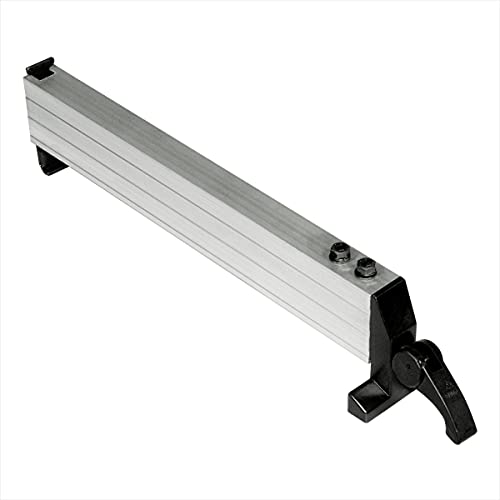
- Fits
- 9 in benchtop saws
- Drift adjust
- Limited
- Resaw support
- Low only
- Extras
- Adjustable clamping range
- Price band
- Around $30 to $40
Purpose made for 9 inch benchtop saws, which is a category the bigger fences ignore entirely. It is a simple square fence with a lock lever, and on a small saw doing small work that is genuinely enough.
Who should buy it
Owners of 9 inch benchtop saws from POWERTEC, WEN, Ryobi, Delta or Craftsman who currently have no fence at all.
What to watch out for
Drift adjustment is limited, so you will still be compensating by hand for a blade with a strong drift angle. The low profile face does not support tall stock, which caps its resaw usefulness.
What works
- Made for 9 in saws, which most fences ignore
- Cheapest way to add a fence
- Simple and quick to set
- Wide compatibility across benchtop brands
What does not
- Limited drift adjustment
- Low face, so poor for resawing
- Only suits small saws
5. Camoo KMS7214 Bandsaw Resaw Guide Fence, Best resaw add on

- Fits
- Most 14 in saws, pairs with KMS7200 style fences
- Drift adjust
- Not required
- Resaw support
- Single point, curved face
- Extras
- Steering allowance
- Price band
- Around $25 to $35
A single point resaw guide is a different tool from a fence, and for resawing it is arguably the better one. The curved face contacts the stock at one point, which means you steer the board to a line rather than fighting a straight fence set at the wrong angle.
Who should buy it
Anyone who resaws and finds drift compensation frustrating. Because contact is a single point, drift becomes something you steer around instead of something you have to measure.
What to watch out for
It is an accessory, not a fence. You still need the fence body it attaches to, and it does nothing for ordinary ripping where a straight face is exactly what you want.
What works
- Single point contact makes drift a non issue
- Lets you steer to a line while cutting
- Cheap addition to an existing fence
- Better than a straight fence for wide resawing
What does not
- Needs a compatible fence to mount to
- Useless for normal ripping
- Requires more operator attention, not less
How to choose a band saw fence
Drift adjustment is the whole point
Every blade cuts at a slight angle to the wheels. A fence you cannot angle to match will produce a cut that runs off the line, and no amount of pushing will fix it. If a fence does not adjust for drift, it will only ever be a stop, not a fence.
How to find your drift angle
Draw a straight line down a scrap board parallel to its edge. Cut along it freehand, going slowly and following the line rather than the fence. Stop halfway and, without moving the board, mark the angle it sits at relative to the table slot or the table edge. That angle is your drift. Set the fence parallel to the board, not to the table. Redo this every time you change the blade.
Height matters for resawing
A low fence face supports a board only at the bottom, which lets tall stock lean away as you feed it. A fence with a tall position, or an auxiliary tall face screwed to the fence, keeps the board vertical through the cut. This is why the two position fences are worth more than the difference in price.
Rigidity beats features
A fence that flexes under feed pressure is a fence that lies to you. Test by locking it and pushing hard at the far end. Any visible movement will show up in your cuts.
Single point guides are the alternative
Instead of a fence set at the drift angle, a single point guide contacts the board at one spot and lets you steer. For resawing this is genuinely easier, because you follow a marked line rather than trusting a setup. Many people end up using both, a fence for ripping and a point guide for resawing.
- Check your table before buying. Some fences need holes drilled, some clamp.
- Find drift every time you fit a new blade, not once.
- Add a tall auxiliary face if your fence is low. It is a scrap of plywood and four screws.
- Wax the table. Feed pressure needed drops noticeably and so does wander.
- A fence will not fix a badly tensioned blade or worn guides. Sort the saw first.
Blade choice interacts with all of this. See best resaw blades for the cutting half of the problem, and the band saws section for everything else.
Frequently asked questions
Do I really need a band saw fence?
For curves, no, you cut freehand. For ripping, resawing and any repeat width, yes. Without one every cut is a freehand cut and consistency is impossible.
What is blade drift and can I eliminate it?
It is the natural angle a blade wants to cut at, caused by tooth set, the weld and tracking. You cannot eliminate it, and a saw that is perfectly set up still has some. You compensate for it with an adjustable fence.
Will a Kreg style fence fit my saw?
Most 14 inch saws, yes, and many need holes drilled in the table. Measure your table and check the mounting pattern before ordering, because 14 inch is a nominal size and tables vary.
Fence or single point guide for resawing?
A point guide is easier for following a line and forgiving of drift. A fence is better for repeat widths. Neither is wrong, and plenty of shops keep both.
Can I make my own band saw fence?
Yes, and a shop made fence clamped at the drift angle works well. What you give up is the scale and quick repeatability, which is what the commercial fences are actually selling.
The bottom line
The Kreg is the fence to buy if the saw matters to your work, because calibrated drift adjustment plus a tall resaw face solves both problems properly and you stop thinking about it.
For most hobby shops the cheaper clone does the same two jobs at half the money, with the caveat that you should check it for square on arrival. And if your saw is small or unusual, the clamp on guide fits anything and drills no holes, which is worth more than a scale you would rarely trust anyway.
Leave a Reply