
A workbench is the one tool in the shop that every other tool leans on. Get it wrong and everything downstream suffers: your saw cuts wander because the surface flexes, your chisel work goes badly because the piece will not stay put, and you spend half of every session chasing a workpiece around a top that will not hold it.
We looked at the woodworking benches people actually buy on Amazon and ranked five of them against what a bench is for: holding wood still, staying flat, and not moving when you lean on it. Three are solid hardwood benches. Two are folding work surfaces, included because a lot of people genuinely do not have room for the first three, and pretending otherwise is not useful.
Top three picks at a glance

WEN 60-Inch Hardwood Workbench (WB6020)
- 60 x 20 in rubberwood
- 300 lb top / 600 lb total
- 7.5 in onboard vise, bench dogs

Magshion 60" Rubberwood Work Bench
- 60 in rubberwood on steel
- 500 lb
- Solid oak vise, removable stop block
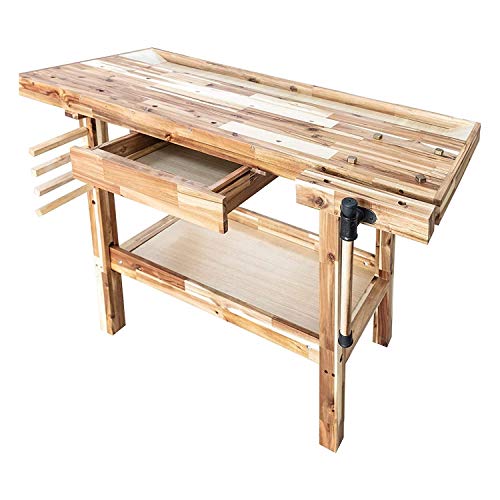
Olympia Tools Acacia Workbench, 48 Inch
- 48 in solid acacia
- 330 lb
- Built-in vise
The five benches compared
| Bench | Top | Capacity | Workholding | Price band | Score |
|---|---|---|---|---|---|
| 1. WEN 60-Inch Hardwood Workbench (WB6020) Best overall |
60 x 20 in rubberwood | 300 lb top / 600 lb total | 7.5 in onboard vise, bench dogs | Around $300 to $350 | 9.1 |
| 2. Magshion 60" Rubberwood Work Bench Best value hardwood |
60 in rubberwood on steel | 500 lb | Solid oak vise, removable stop block | Around $200 to $220 | 8.6 |
| 3. Olympia Tools Acacia Workbench, 48 Inch Best compact hardwood |
48 in solid acacia | 330 lb | Built-in vise | Around $150 to $180 | 8.0 |
| 4. WORX Pegasus WX051 Folding Workbench Best portable |
31 x 25 in ABS | 300 lb as a bench, 1,000 lb as a sawhorse | Clamps and dogs included | Around $130 to $150 | 7.8 |
| 5. Keter Heavy-Duty Folding Workbench Best budget |
Polypropylene on aluminum legs | 1,000 lb | 12 in clamps, horizontal or vertical | Around $100 to $120 | 7.4 |
1. WEN 60-Inch Hardwood Workbench (WB6020), Best overall
- Top
- 60 x 20 in rubberwood
- Capacity
- 300 lb top / 600 lb total
- Workholding
- 7.5 in onboard vise, bench dogs
- Storage
- Four drawers, lower shelf
- Price band
- Around $300 to $350
This is the one that behaves like a real woodworking bench rather than a table with a vise bolted to it. Sixty inches of solid rubberwood gives you room to lay out a cabinet door, the onboard vise and dog holes mean you can actually hold work down for handwork, and four drawers keep chisels off the top where they belong.
Who should buy it
Anyone setting up a garage shop who expects to do handwork as well as assembly. If you plan to plane, chisel, or hand cut joinery, the vise and dog holes are not optional extras, they are the whole point.
What to watch out for
The 300 pound top rating is modest for the price, and rubberwood is on the softer end of the hardwoods, so expect it to mark. Assembly takes a while and the drawer slides are the part owners most often mention wearing.
What works
- Genuine vise and dog holes, not an afterthought
- 60 inches of usable layout space
- Four drawers plus a lower shelf
- Two year warranty
What does not
- The most expensive bench here by a clear margin
- Rubberwood dents more easily than maple or beech
- Long assembly
2. Magshion 60" Rubberwood Work Bench, Best value hardwood
- Top
- 60 in rubberwood on steel
- Capacity
- 500 lb
- Workholding
- Solid oak vise, removable stop block
- Storage
- Drawer, lower shelf
- Price band
- Around $200 to $220
The same 60 inch footprint as the WEN with a higher load rating and a steel frame under the top, for meaningfully less money. You give up three drawers and some refinement, and you gain rigidity. For most people building a first serious bench, this is the sensible trade.
Who should buy it
The woodworker who wants a hardwood top and a working vise without paying flagship money, and who would rather have a steel frame than a drawer bank.
What to watch out for
A wooden vise screw is slower and less powerful than a steel one, and the single drawer fills up fast. Check the top for flatness on arrival, because a bench that arrives twisted is a bench you will fight forever.
What works
- 500 pound capacity, the highest of the hardwood benches here
- Steel frame under a hardwood top
- Oak vise clamps without marking your work
- Removable stop block for planing
What does not
- Only one drawer
- Wooden vise screw is slow to wind
- Assembly quality is variable
3. Olympia Tools Acacia Workbench, 48 Inch, Best compact hardwood
- Top
- 48 in solid acacia
- Capacity
- 330 lb
- Workholding
- Built-in vise
- Storage
- Central drawer, open lower shelf
- Price band
- Around $150 to $180
Acacia is harder and more dent resistant than rubberwood, which matters more than the twelve inches of length you lose. If your shop is a single bay garage or a shed, a 48 inch bench you can walk around beats a 60 inch bench you have to squeeze past.
Who should buy it
Small shops, sheds, and anyone who has to share floor space with a car. Also the best pick if you want a hardwood top but do not need a drawer bank.
What to watch out for
Forty-eight inches is short for breaking down long stock, and the 330 pound rating is the lowest of the three hardwood benches. The integrated vise is small, so plan on adding a proper face vise later if you get serious about handwork.
What works
- Acacia takes a beating better than rubberwood
- Fits a single bay garage
- Vise and drawer included at this price
- Simple, sturdy construction
What does not
- Short top for long stock
- Lowest load rating of the hardwood benches
- Small vise
4. WORX Pegasus WX051 Folding Workbench, Best portable
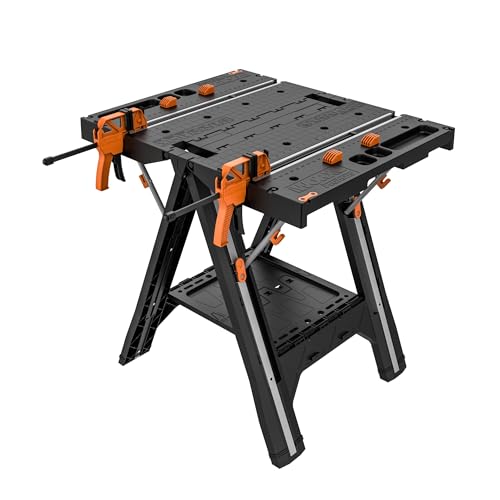
- Top
- 31 x 25 in ABS
- Capacity
- 300 lb as a bench, 1,000 lb as a sawhorse
- Workholding
- Clamps and dogs included
- Storage
- None, folds flat
- Price band
- Around $130 to $150
Not a woodworking bench and it does not pretend to be. What it is, is the best folding work surface for people without a dedicated shop: it opens in seconds, converts to a sawhorse, and links to other Worx tables when you need a bigger outfeed.
Who should buy it
Anyone working out of a garage that has to become a garage again by Sunday night, and site carpenters who need a surface that travels.
What to watch out for
An ABS top flexes. You can assemble on it and cut on it, but you cannot plane or chop against it the way you can on a hardwood bench, and it will not hold a workpiece still under hand pressure.
What works
- Folds flat in seconds
- Converts to a 1,000 pound sawhorse
- Links to other Worx tables
- Light enough to carry one handed
What does not
- Plastic top flexes under handwork
- No storage
- Small surface next to a real bench
5. Keter Heavy-Duty Folding Workbench, Best budget

- Top
- Polypropylene on aluminum legs
- Capacity
- 1,000 lb
- Workholding
- 12 in clamps, horizontal or vertical
- Storage
- None, folds flat
- Price band
- Around $100 to $120
The cheapest honest way to get a stable surface under a miter saw. No assembly, opens in half a minute, folds against a wall, and the thousand pound rating is real enough for supporting sheet goods and machines.
Who should buy it
First time buyers, renters, and anyone who mainly needs somewhere to put a miter saw and break down plywood. Also a good second surface once you own a proper bench.
What to watch out for
Read the capacity properly: a thousand pounds spread evenly across the top is not the same as a rigid surface for handwork. This is a support table, not a woodworking bench, and treating it as one will disappoint you.
What works
- Ready in about thirty seconds, no assembly
- Genuinely high distributed load rating
- Weather resistant, will live in a carport
- Clamps included
What does not
- Resin top is not a woodworking surface
- No vise, no dog holes
- No storage
How to choose a woodworking workbench
Five things decide whether a bench is worth owning. Everything else is a preference.
Top material comes first
Solid hardwood is the only surface that lets you work against the bench rather than just on it. Beech and maple are the traditional choices and the hardest wearing. Rubberwood and acacia, which is what you find at this price, are softer, so they will dent, but they are stable and flat and they take a plane iron without complaint. Resin and ABS tops are fine for assembly and for standing a miter saw on. They are not fine for handwork, because they flex under the pressure you need to apply.
Size, and the size you can actually fit
Sixty inches is the point where a bench stops feeling cramped. You can lay out a cabinet door, clamp a long board for edge jointing, and still have somewhere to put the tool you just picked up. But a 60 inch bench in a single bay garage that you also park in is a bench you will resent. Measure the floor, then measure the walking space around it, then buy.
Height matters more than people expect
The old rule is that a bench top sits at the height of your wrist when you stand with your arms at your side, which for most adults lands somewhere between 33 and 36 inches. Too low and you will hurt your back planing. Too high and you lose the ability to put your body weight over the work. If a bench arrives at the wrong height, blocks under the legs or a trim off the bottom is a twenty minute fix, so do not reject an otherwise good bench over an inch.
Rigidity beats the number on the box
A capacity rating tells you what a bench will hold sitting still. It says nothing about racking, which is the sideways wobble you get when you push a plane along a board. A steel frame or a decent stretcher arrangement matters more than a big number. If a bench racks, everything you do on it is slightly wrong.
Workholding is the whole point
A vise and a row of dog holes turn a table into a bench. Without them you are holding work with one hand and a tool with the other, which is slower and less accurate and occasionally dangerous. If a bench you like has no vise, budget for a face vise and the afternoon it takes to fit one.
What to spend
- Under $150: a folding support table. Good for a miter saw and for breaking down sheet goods, not for handwork.
- $150 to $250: a compact hardwood bench with a basic vise. This is where a real bench starts.
- $250 to $400: a full 60 inch hardwood bench with proper workholding and storage.
- Above $400: you are into cabinetmaker territory, or you build your own, which is often the better value.
Frequently asked questions
What is the best workbench height for woodworking?
Roughly wrist height when standing, which is 33 to 36 inches for most people. Lower suits hand planing because you can get your weight over the tool. Higher suits joinery and assembly where you want to see what you are doing.
Is a hardwood top worth the extra money over a resin one?
If you do any handwork, yes, and it is not close. A hardwood top holds a workpiece still, takes clamping pressure, and can be planed flat again when it wears. A resin top does none of those things. If you only ever assemble and use power tools, a folding resin table will serve you fine.
How much weight should a woodworking bench hold?
For hobby woodworking, 300 pounds of rated capacity is enough for the work itself. What you actually want is a frame that does not rack. A 500 pound bench with a steel frame will feel far more solid than a 1,000 pound folding table with legs that flex.
Can I put a vise on any workbench?
On a hardwood bench, yes. You need enough thickness to take the mounting bolts and a firm edge to register against. On a resin or ABS folding table, no. There is nothing there to bolt into that will survive the leverage a vise applies.
Is it cheaper to build a workbench than buy one?
Usually yes on materials alone, but the gap narrows once you count hardware, finish and your own time. We ran the numbers properly in a separate piece: is it cheaper to buy or build a workbench?
The bottom line
If you have the space and the budget, the WEN 60 inch is the bench here that behaves like a bench: hardwood top, real vise, dog holes, and drawers to keep the top clear. The Magshion gets you most of the way for meaningfully less and adds a steel frame, which is the trade we would make on a tighter budget.
In a small shop, the Olympia acacia bench is the honest answer, because a bench you can walk around beats a longer one you cannot. And if you are not ready for a fixed bench at all, the Worx Pegasus and the Keter are good support tables that know what they are, which is more than most of this category manages.
Leave a Reply